
Ferrous Sulphate Heptahydrate - Overview
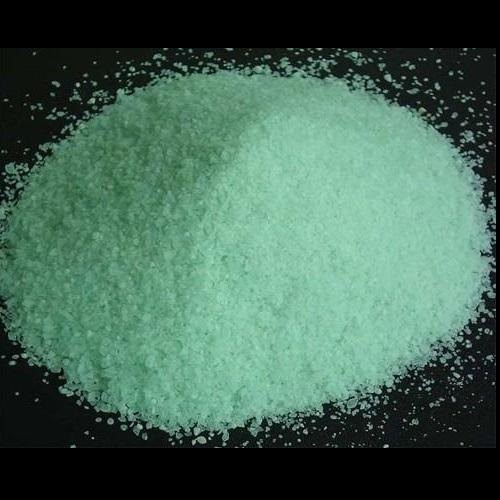
Ferrous sulphate heptahydrate or also known as green vitriol and coperras with IUPAC name of Iron (ll) sulfate has a chemical compound of FeH14O11S. This compound exists most commonly as heptahydrate form and it is highly soluble in water to produce the complex [Fe(H2O)6]2+, which has octahedral molecular geometry and is paramagnetic. Ferrous sulphate heptahydrate belongs to the pharmacological groups called hematological agents and iron salts. It is used as a source of iron for iron-deficiency anaemia patients.

Manufacturing Process
Ferrous sulfate monohydrate is obtained from a pickling solution containing ferrous chloride, hydrochloric acid and water and reacted in a precipitating reactor in the presence of excess sulfuric. Ferrous sulfate monohydrate is then converted in a crystallization reactor in the presence of water into ferrous sulfate heptahydrate as crystallized product. After which, water is isolated from the ferrous sulfate heptahydrate.
The Uses of Ferrous Sulphate Heptahydrate
Ferrous Sulphate Heptahydrate can be used as anemia iron deficieny prevention, colorant, water treatment, animal feed, and plant grower.
Medical use
As mentioned before, this compound plays an important role to treat and prevent iron deficiency anaemia. It helps to supply iron twice the number of ferrous gluconate tablets, thus ferrous sulphate heptahydrate is the most commonly prescribed for oral iron therapy in many countries.
Colorant
Ferrous sulphate heptahydrate has been used for colorant since middle ages. Nowadays, this compound is a useful source of iron, water soluble, and easy to handle. In pigment production, this compound is often used to produce red, yellow, and black iron oxide pigments.
Water treatment industry
Ferrous sulphate heptahydrate can be used in water treatment industry directly in municipal and industrial water treatment plants to enhance the coagulation process and removal of elements such as phosphorus. It also prevents eutrophication of surface water bodies.
Feed industry
Ferrous sulphate heptahydrate can also transforms into other chemical such as ferrous suphate thermal monohydrate by drying process. The product itself has a high concentration of iron approximately 30% and it can be used as additional nutrient for animals.
Plant growth
In the soil with a high pH, ferrous sulphate heptahydrate can help to lower the pH so that the soil’s nutrients can be absorbed by the plants. Besides lowering soil’s pH, ferrous sulphate heptahydrate can also treats iron chlorosis in horticulture and has a longer-lasting effect than ferric EDTA.

Hazards Identification
Potential Acute Health Effects: Hazardous in case of skin contact (irritant), of eye contact (irritant), of ingestion, of inhalation.

Potential Chronic Health Effects:
Potential Chronic Health Effects: CARCINOGENIC EFFECTS: Not available.
MUTAGENIC
EFFECTS: Mutagenic for bacteria and/or yeast.
TERATOGENIC EFFECTS: Not available.
DEVELOPMENTAL TOXICITY: Not available.
The substance is toxic to liver. The substance may be toxic to kidneys, cardiovascular system, central nervous system (CNS). Repeated or prolonged
exposure to the substance can produce target organs damage.
PRODUCT IDENTIFICATION
| Chemical Formula | FeSO4·7H2O |
| Synonym | Iron(II) sulfate heptahydrate; Presfersul; Melanterite mineral; |
| Origin | China |
| H.S. Code | 2833.29.00 |
| CAS No. | 7782-63-0 |
| Molecular Weight | 151.9 g mol-1 |
PRODUCT SPECIFICATION
| Property | Units | Value |
|---|---|---|
| Appearance | - | Blue or Green Crystals |
| Purity | % | 99.0 |
| Density at 20°C | g/cm3 | 1.89 |
| Melting point | °C | 64 |
| Boiling point | °C | 330 |
| Solubility in Water | - | 25.6 g/100mL (20 ºC) |
| Storage condition | °C | 2-8 |